Value Capture Financing and ST3
Exploring a Value Capture Tax
As you may have heard, SoundTransit is facing a significant budget issue. ST3, approved by voters in 2016, is meant to deliver the West Seattle Link Extension, the Ballard Link Extension, the 4 line from Issaquah to South Kirkland and more. A few months ago SoundTransit announced a 34 billion dollar budget gap and despite their best efforts have had to make a lot of significant concessions, most notably terminating the Ballard line at Seattle Center, eliminating the entire project’s highest ridership station.
Sound Transit should consider a Value Capture tax to pay for this irreplaceable service.
A Value Capture taxes function by making a very powerful inference. When rapid transit is built, land around the stations becomes more valuable. Often dramatically more so. In a normal transit-building scenario, the additional tax collected from the land value increase goes to the same services that they typically would have. More money for the City and County Budget, more money for the Schools, etc. All made possible by the train. Increased property value and tax revenue from transit is clearly a good thing, and is yet another reason that building rapid transit is an amazing decision.
TIFs
There are a few different types of Value Capture Taxes, the main one I will be speaking about to today is called Tax Increment Financing, often referred to as TIF. Tax increment financing operates by taking out a large loan, ‘freezing’ the property values at a certain number and point in time, and then allocating any additional tax gained from an increase in property value to pay back the loan that funded the project.
As we all know, the Ballard Link Extension is in serious jeopardy. If the extension all the way to 15th and Market doesn’t happen, or is delayed until 2060 (🤮), there will be billions of dollars in property tax income (among many other significant benefits) left vanishing into thin air. This would be a truly historic fumble. Instead, SoundTransit can fund itself by capturing the future property value increase!
That increased value will literally not exist if the project doesn’t happen. The increased value will exist if the project does happen.
Please note that for this article, I am speaking exclusively about land value, not the improved value upon the land. Read about the difference here. Also note that improvement value around the rapid transit stations, unaffected by a value capture tax, typically increases substantially. This creates tax revenue for the city that usually well outpaces the value lost to the financing vehicle.
The chart below shows a bit about the projected values of a TIF in the case of Ballard Station.
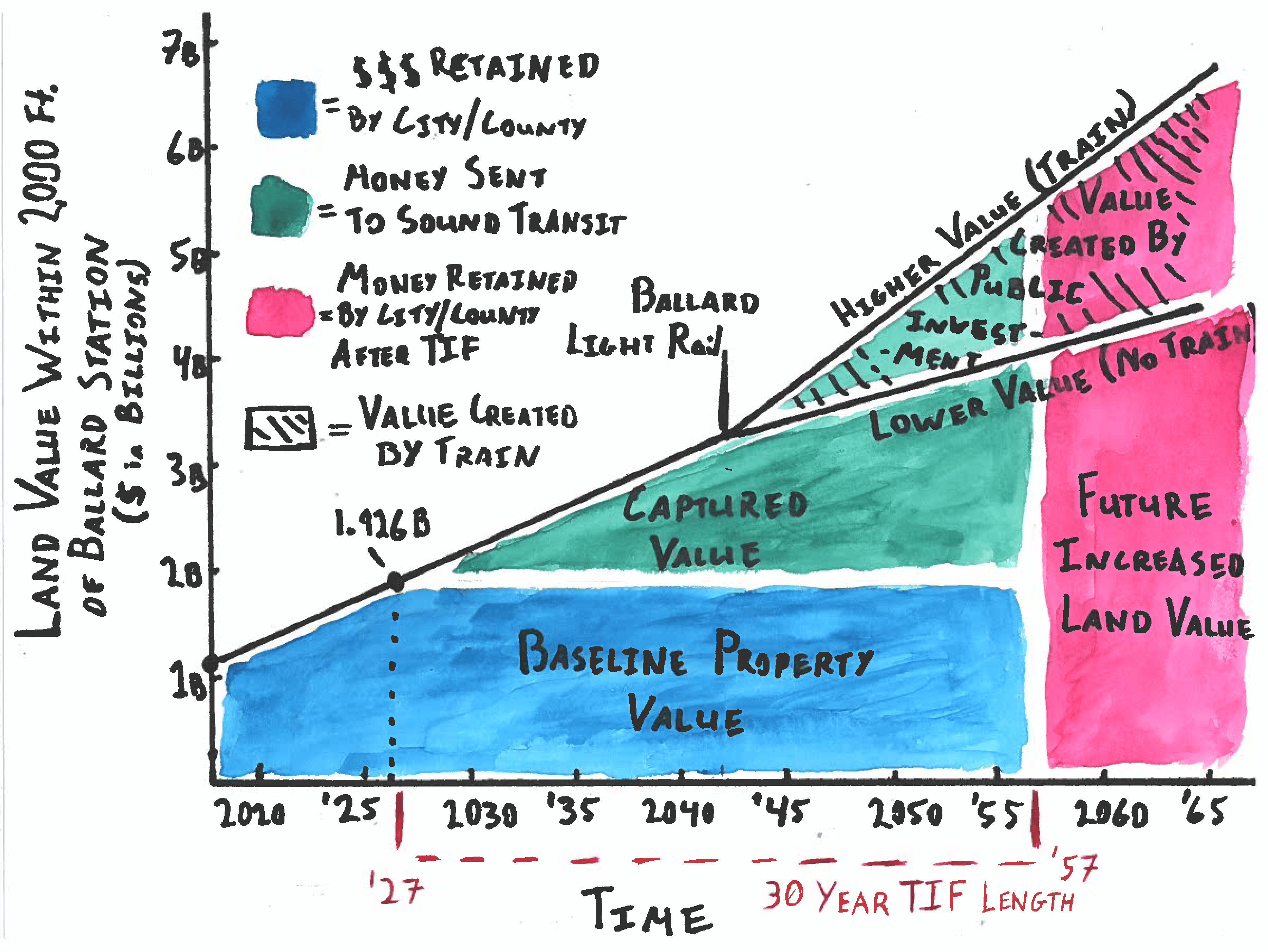
The image above is illustrative and is meant to communicate the general idea of a TIF, and not to calculate exact numbers. The 30 year TIF term is not set in stone and is often adjusted based on the amount of money the TIF zone brings in. The $1.077 Billion in 2018 and $1.926 Billion in 2027 are both real data points representing the land value within 2000 feet of 15th and Market. All other data seen are projected.
Elsewhere in Seattle
Value Capture taxes are not novel in our city. We can look to a recent example, a Local Improvement District (LID) funding a prominent Seattle victory, Waterfront Park. Completed in 2025, Waterfront park is the culmination of the project started long ago with Bertha digging what is now the 99 tunnel and the teardown of the Viaduct. This has become an amazing part of our city and was recently on display during the World Cup. Without taxing the district directly benefitting the most, the Waterfront Park project may not have been possible and the benefitting properties would not have found the same increase in value to their land.
LIDs are similar to TIFs but directly tax property owners in the region rather than ‘capturing’ a portion of the increased tax revenue like a TIF does. Read about Seattle’s Waterfront park LID here, and LIDs in general here.
Now for some light data analysis
The area around 15th and Market in Ballard is currently valuable land, but will become much more so if and when the light rail is completed. If you go there today, there is a huge amount of car activity, as well as plenty of space dedicated to the personal automobile. That space looks like large parking lots at Walgreens and Safeway, a gas station, the gigantic right of way of the streets themselves and more.
Comparing 2018 with 2027
For this data analysis and visualization I took data from the King County Assessor, who publishes an extensive data download page with property tax information going back over 15 years. For this analysis I used the most up to date data, 2027, to compare with data from 2018. Check out this chart showing the mean increase in land value in the 2000 feet around various light rail stations and non light rail stations. I chose to exclude downtown and SODO light rail stations from this analysis because of their differences with proposed Ballard Station.
Below is a bar graph showing the amount that land around various points has increased in value over the past nine years. Note the clear increase around the lightrail stations. Correlation or causation?
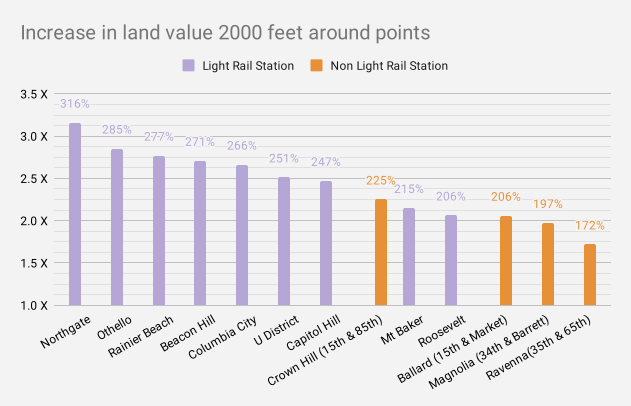
Now let’s visualize some of those numbers. First, take a look at this map of the entire city, aggregated into hexagons, showing the median increase from 2018 to present in that hexagon. You can almost see the path of the light rail. The northern stations (U-District, Roosevelt, and Northgate) have only been open since 2021, but the stations in South Seattle all have had time to reap the benefits of the train access and are significantly more valuable than they were in 2018.
Land Value 2018 vs 2027, Aggregated into Hexagons
Now take a look at the map below, showing individual parcels in the 2,000 foot radius around their respective center points.
9 Light rail station areas and 4 notable non light rail areas (2000 foot radius)
Note that in the 9 years between the 2018 and 2027 assessments, some parcels have been divided and new ones created in their place. Consequently, a direct 1 to 1 comparison is not possible in those instances. For to this reason, as well as certain public property not being evaluated in the same way (Public Universities, Parks), not all parcels will show in these maps. This applies, albeit less frequently, to the aggregated hexagon maps.
Additionally, you may have noticed some sections where there are groups of parcels that all uniformly increased in value, such as in the eastern portion of the Ballard circle. This is usually caused by upzoning which makes the land instantly more valuable, as more types/density can be added to those lots.
Directly Applied to Ballard, with some math
The land in a 2000 foot radius around Ballard Station (15th and Market) is currently worth $1,926,924,400, close to 2 billion Dollars. Seattle’s property tax rate is just shy of 1% (often denoted as $10 per $1000 in value), meaning that the land around Ballard Station brings in about $19,269,000, or $19 million. If a TIF district were to be made for those properties, and it grows about 2.5 times in 9 years, as can be reasonably expected based on value growth surrounding light rail stations since 2017 (see initial bar graph), we can translate that to 10% per year (Actually 10.7%, but we’re lowballing). If that 10% per year is ‘Captured’ and all the growth from $19.27 million goes to funding ST3, the growth would yield $114 million in its first decade, $718 million in its first 20 years and a generous $2.59 billion in a 30 year period. 2.59 billion is a significant portion of the nearly $12 billion that the Ballard Link Extension and downtown tunnel cost (see this document for ST price estimates).
This $2.59 billion over 30 years at 10% value growth per year may not be realistic. There are a huge amount of variables at play here, such as the radius of the financing zone, the percentage of the value increase allocated to SoundTransit, the increase in land value and more. Also keep in mind that this was calculated for just one station, but could be applied to many more stations, such as Interbay, Smith Cove, the extremely high land value Denny station, and even stations on the West Seattle and 4 lines.
The point is that a Value Capture Tax should be considered here. It finds a lot of money for transit that otherwise would not exist. Ballard station will provide staggering positive externalities to the community, and if the agency executing the project can capture just some of them, maybe the train will actually see the light at the end of the tunnel.
Thanks for reading. You can check out my code for the project here, and please don’t hesitate to reach out with your thoughts at aaron.m.schechter@gmail.com.
Below are some more sources I used to learn about Value Capture tax and Tax Increment Financing.
FTA value capture info page
‘Legal Clarity’ description of TIFs
Large PSRC Study on Value Capture
Washington Specific TIF info page
LID vs. TIF